Mastering New Year’s Resolutions: A Success Framework

Humans have been making a fresh start at the New Year for at least 4,000 years, when the Babylonians reportedly made resolutions like pledging to return borrowed farm equipment. (Old Farmer’s Almanac) Who among us hasn’t made at least one New Year’s resolution in our lifetime? If you’re in the “never have I ever” camp, be honest: haven’t you reflected on a plan of action at the start of the year, most likely calling them #goals?Regardless of whether you’ve called it a resolution or a goal, how many of us have broken it within a week, two weeks, a month? I know I have – and often! And I have equally always beaten myself up for breaking my New Year’s plan for change, calling myself weak or even useless. But it turns out that I am not alone in breaking my New Year’s resolve: studies show that 80 to 90 percent of New Year’s Resolutions fail within a month, by February. (Norcross & Vangarelli, 1989) Experts agree that the problem isn’t the who (ourselves) or the what (the resolution or goal) but the how (the way we set and execute our goal). The framework for success? It’s three-fold: build on a solid foundation, find your framework, and set your system.

Build on a Solid Foundation: Values

Values are the bedrock from which our basic psychological needs for competency, self-determination, and connection can be met. If we align our lived experience, our actions, our social networks to our values, our intrinsic motivation increases with positive effects on our performance as well as on our physical and mental health: “…intrinsic motivation, autonomous regulation of extrinsic motivation, and intrinsic aspirations were associated with positive affective experiences; high-quality performance, particularly on heuristic activities; maintained change of healthy behaving; and better mental health.” (Deci & Ryan, 2000) By aligning our lives with our values, we increase our likelihood of success in achieving our goals or meeting our resolutions. This is what people mean when they ask us “What’s your “why”?” which is a question first posed in a 2009 TED Talk by Simon Sinek. Values, studies have shown, are not static; they change over time for each of us. Donette Nobel and Jeni McRay, the authors of “Defining My Personal Values,” Chapter 2 of Developing Human Potential, an Open Educational Resource book published by the University of Nebraska System, offer a road map for identifying your current personal values.

Find Your Framework: SMART, SMARTER – or not?

Google “setting a goal that sticks” and you will find SMART goals at the top of the list. SMART stands for Specific, Measurable, Achievable, Relevant, (or Realistic) and Time-Bound (or Timely). Another variation is SMARTER which stands for Specific, Measurable, Achievable, Relevant/Realistic, Time-Bound/Timely, Evaluate, Re-adjust. The SMART or SMARTER goal setting framework is touted as the gold standard not only for setting goals but for achieving them as well, with a demonstrably high success rate. However, there is some doubt as to their efficacy for all types of goals: “Essentially, when people are confronted with a task that is new and/or complex for them, a non-specific goal allows the systematic exploration and discovery of appropriate strategies while reducing one’s focus on attainment goals, whereas a specific goal increases the difficulty of finding an appropriate strategy and can increase performance anxiety around trying to achieve the set standard (Locke & Latham, 2013).” (Pietsch, et al., 2024) For less specific goals, especially learning goals, do-your-best (DYB) or open goal frameworks, which focus on personal growth, effort,  and improvement, can be more effective than the rigid structure offered by the SMART/SMARTER framework. For some of us, creating a vision or mood board, writing a bucket list, making and listening to a manifestation playlist, or saying a daily affirmation may be all we need not only to set the intention but to achieve the goal. Ultimately, you need to decide for yourself how best to formulate your goals, but across all studies the key to making ones that stick is to write them down.

Set Your System(s): Daily Habits

“Every action you take is a vote for the person you want to become.”

James Clear

James Clear, author of Atomic Habits, argues that it is neither the goal nor the framework you use to set it that ultimately leads to success, but what he calls the systems, the habits that you put in place and follow daily: “Goals are good for setting a direction, but systems are best for making progress.” Clear’s work builds on previous work by Stephen R. Covey (1989’s The 7 Habits of Highly Effective People) and BJ Fogg (creator of the Fogg Behavior Model, first published in 2009, and author of 2019’s Tiny Habits: The Small Changes that Change Everything). BJ Fogg is the Stanford behavior scientist who encouraged people to build new habits by habit stacking, that is, by incorporating a new habit into your already-existing routine, leveraging what Clear calls the “connectedness of behavior” to make the new habit easy to assimilate into your life. Fogg created the field of behavior design back in the early 2000s with groundbreaking work that led to the Fogg Behavior Model (FBM): “The FBM asserts that for a person to perform a target behavior, he or she must (1) be sufficiently motivated, (2) have the ability to perform the behavior, and (3) be triggered to perform the behavior. These three factors must occur at the same moment, else the behavior will not happen.” I didn’t realize thirty years ago when I started doing Diane von Furstenburg’s ballet stretches and exercises while watching the morning news or my favorite TV shows in the evenings that I was habit stacking – but that is, essentially, what makes implementing a new goal much less likely to fail. Indeed, I incorporated the goal of stretching every morning before going about my day successfully into my daily routine in my early 20s and maintained it into my early 50s. Clear and Fogg encourage layering the new habit, or nesting the new habit, into your existing schedule or to-do list so that your old habits become cues for the new habit.

“Habits are the compound interest of self-improvement.”

James Clear

The 21-Days Myth

How long does it take to form a habit? Pop psychology claims it takes 21 days to form a habit but a 2009 study (published in 2011) found that though habit formation is highly individualized, it takes an average of 66 days for new behaviors (like eating a piece of fruit with lunch every day, drinking a bottle of water with lunch every day, or running for 15 minutes before dinner) to become habits. Of course, in order for this to happen, the behavior must be repeatedly sustained; daily repetition becomes automaticity: “Results showed that behaviour change was initially experienced as cognitively effortful but as automaticity increased, enactment became easier.” (Lally, et al., 2011) Over the two years of their longitudinal study, Deci and Ryan found that people who successfully incorporated and achieved their goals for the entire two years had an average of 14 slips before actual maintenance of the goal(s) set in. It’s best to remember, too, that the more complex a new behavior is, the longer it will take to master and to make it a habit.

Rewards: Immediate, Positive, and Small

Most people set a goal with a reward at the end of it, such as giving themselves a Saturday  shopping trip or a movie if they make their goal of going to the gym three times in one week. However, the author of the aforementioned 2009 study on habit formation, Phillippa Lally, found that a reward is much more effective if you receive it during the task you’re trying to form into a habit. So that Netflix movie you promised yourself you could watch on the weekend if you were “good” all week? Watch it while you work out instead! This gives your brain positive reinforcement (similar to a dopamine hit) while linking it to the habit. The hard part is deciding on a reward that will deepen your habit (eating an ice cream after working out is counterproductive for weight loss goals, for example). A 2018 study found that a reward must also be perceived to be pleasurable, where “[p]leasure is defined as a positive and immediate sensory outcome, similar to the food or drug rewards commonly used in the animal literature. Physical pleasure may thus serve as a reward in human habit formation.” (Judah, et al., 2018) The key, then, is to give yourself rewards that deepen your pleasure in the behavior in order to create a habit that sticks.

Motivation: Intrinsic Is the Only Way To Go!

“Intrinsic motivation (being motivated to act due to the anticipated inherent enjoyment of doing so) is more likely to lead to stronger intentions and sustain changes in behaviour than extrinsic motivation (being motivated to act to achieve a desired outcome of the behaviour, e.g. pleasing others). Observational studies of existing fruit consumption and exercise habits found that greater intrinsic motivation was associated with stronger habits, and reinforced the relationship between behavioural repetition and habit.” (Judah, et al., 2018)

The importance of intrinsic motivation, motivation that comes purely from the satisfaction of doing something, the pleasure and joy from the activity or task, is the biggest key to making your resolution or goal stick for the long term. Every study has shown this, and, honestly, it’s just common sense, isn’t it? 

I tell my students to aim for the quality of their work, to measure their work against each strand of the rubric, and to complete their work on time and turn it in (you’d be surprised how many students of all ages, from 12 to 18, forget to click Turn In on Google Classroom!) and the grade takes care of itself. The same holds true for absolutely everything and James Clear says it, too, in two quotes: “Fix the inputs and the outputs will fix themselves.” and “Ultimately, it is your commitment to the process that will determine your progress.”

2026: Universal Year 1, A Fresh Start for the Collective and for You!

New Year, New You? Maybe. Perhaps. 2026 is a Universal Year 1, and the first Fire Horse in 60 years, which means its energy calls for a fresh start, bold leadership, the courage to act for the good of the collective, the greater good, as well as for yourself on an individual level. Start that new project or launch that side hustle that you’ve been thinking or dreaming about! Begin planting the seeds for the future you dream of! Manifestation is all about energy, and energy flows to where you direct it. Even James Clear says words to this effect in Atomic Habits:  “Time will multiply whatever you feed it. Good habits make time your ally. Bad habits make time your enemy.” (Clear, J., 2025, 3-2-1 Newsletter)

Just remember not to get hung up on slips. Slips are always part of the process. The trick is to acknowledge them, learn from them what you can, and start fresh again. As no doubt you have heard many times, showing up is the win, everything that follows is truly a blessing: problems give us the opportunity to discover flaws in our process, in our systems, and to make improvements; easy days make us grateful that we have built the systems that made “easy” possible.

New Year, Same Me – But with New Habits

My New Year’s resolutions for 2026? I have so many things to conquer, the top among them being my analysis paralysis, thanks to my ADHD but also to my fear of failure. My environment has become so cluttered, it’s exhausting. So that is the first thing I am conquering in 2026. I value peace, curiosity, learning, exploration – which I haven’t felt much of in 2025. January is the winter of Universal Year 1, and my personal tarot card is the Devil, which according to tarot.com “represents the chains we place on ourselves” and “…the illusions that keep us feeling stuck” (see the connection to my analysis paralysis?!), so I am planting the seeds for 2026 and beyond. If not actually decluttering (that will still take some work: 2025 has been a grieving year for me, grieving and letting go of some more of the past) at the very least I will organize and make physical space for the intangible blessings I would like to manifest. I’m starting small (but it feels very big!) and chunking new small habits into my existing ones in order to make sure that these changes stick, to set the stage for my last act. I am writing and researching (others call it running down rabbit holes, but I love the journeys!), getting out and about even if on small excursions, and generally living in my happy place, which is the intrinsic motivation I need to keep up! 

What are you doing to kick off this Year 1? What are you adding to the collective and to your own personal happiness? How do you envision your 2026?


“Whenever you are stuck searching for the optimal plan, remember:

Getting started changes everything.”

– James Clear

July 17, 2025 3-2-1 Newsletter

References

Bardach, L. & Murayama, K. (2025) The Role of Rewards in Motivation – Beyond Dichotomies. Learning and Instruction, Volume 96, April 2025, 102056, ISSN 0959-4752, https://doi.org/10.1016/j.learninstruc.2024.102056. (https://www.sciencedirect.com/science/article/pii/S095947522400183X)

Clear, J. (2018) Atomic Habits: An Easy & Proven Way to Build Good Habits & Break Bad Ones. Avery, an imprint of Penguin Random House

Deci, E. & Ryan, R. (2000). The “What” and “Why” of Goal Pursuits: Human Needs and the Self-Determination of Behavior. Psychological Inquiry. 11. 227-268. 10.1207/S15327965PLI1104_01.

Di Domenico SI, Ryan RM. The Emerging Neuroscience of Intrinsic Motivation: A New Frontier in Self-Determination Research. Front Hum Neurosci. 2017 Mar 24;11:145. doi: 10.3389/fnhum.2017.00145. PMID: 28392765; PMCID: PMC5364176.

Fogg, BJ. (2009). A behavior model for persuasive design. 40. 10.1145/1541948.1541999.

Judah G, Gardner B, Kenward MG, DeStavola B, Aunger R. Exploratory study of the impact of perceived reward on habit formation. BMC Psychol. 2018 Dec 20;6(1):62. doi: 10.1186/s40359-018-0270-z. PMID: 30572936; PMCID: PMC6302524.

Lally P, Wardle J, Gardner B. Experiences of habit formation: a qualitative study. Psychol Health Med. 2011 Aug;16(4):484-9. doi: 10.1080/13548506.2011.555774. PMID: 21749245.

Locke, E. A., & Latham, G. P. (2013). Goal setting theory, 1990. In E. A. Locke & G. P. Latham (Eds.), New developments in goal setting and task performance. (pp. 3–15). Routledge/Taylor & Francis Group. https://doi.org/10.4324/9780203082744

Nobel, Donette, and McRay, Jeni. (2023) Defining My Personal Values. In G. S. Matkin, J. Headrick, & H. M. Sunderman (Eds.), Developing Human Potential: A Personal Approach to Leadership. (Chapter 2). Department of Agricultural Leadership, Education, and Communicationat the University of Nebraska – Lincoln. https://doi.org/10.32873/unl.dc.oth.015.

Norcross JC, Vangarelli DJ. The resolution solution: longitudinal examination of New Year’s change attempts. J Subst Abuse. 1988-1989;1(2):127-34. doi: 10.1016/s0899-3289(88)80016-6. PMID: 2980864.

Oudeyer PY, Kaplan F. What is Intrinsic Motivation? A Typology of Computational Approaches. Front Neurorobot. 2007 Nov 2;1:6. doi: 10.3389/neuro.12.006.2007. PMID: 18958277; PMCID: PMC2533589.

Pietsch, S., Riddell, H., Semmler, C., Ntoumanis, N., & Gucciardi, D. F. (2024). SMART goals are no more effective for creative performance than do-your-best goals or non-specific, exploratory ‘open goals.’ Educational Psychology44(9–10), 946–962. https://doi.org/10.1080/01443410.2024.2420818

How to Plan Your First Mini Retirement

Who among us hasn’t dreamed of getting off the 9-5 grind? Come on, admit it – isn’t resigning from work the first thing you’d do if you hit the lottery jackpot? Even those among us who love what we do for work have had moments – possibly on those mornings when we’ve exhausted our snooze limit and it is so hard to get up, get ready, and join the sluggish morning commute – of wishing we could just close our eyes and not have to do it. Moments of wishing we could just wake up, have a leisurely breakfast, and choose our own adventure. Well, that is exactly what some Gen Zers (people born between 1997 and 2012, also known as zoomers) who have entered the workforce are increasingly doing: taking a career break, a mini or micro retirement.

Definition of “micro” or “mini” retirement

A mini- or micro-retirement is a usually unpaid break from employment. Older generations are a bit flummoxed by this, wondering whether this trend isn’t just a new name for an extended vacation or a sabbatical. And, actually, a mini-retirement can be any or all of those things. Timothy Ferriss coined the term “mini-retirement” back in 2007, in his best-selling The 4-Hour Workweek. Timothy Ferriss coined the term “mini-retirement” back in 2007, in his best-selling The 4-Hour Workweek. Ferris’ book was on The New York Times Best Seller List for four years (or for seven, according to one New Yorker article). At the time, the workforce took Ferriss’ suggestions superficially, as time hacks in order to do more in the regular 40 hours (or 60, 70, 80, depending on your industry). However, in it, Ferriss is really asking society to re-think its connection to work and to redefine its work ethic. Instead of staying on what he terms the “deferred-life plan,” that treadmill where you use the best years of your life earning money in the hope that you will be able to fulfill your soul dreams or passion projects at the end of your life – even though retirement might not even be an available thing for many in the current workforce – Ferriss advocates taking the time in the present to enjoy those things: “There is a way to get the rewards for a life of hard work without waiting until the end.” (p. 8) Enter “lifestyle design” and the “mini-retirement.”

Lifestyle Design

While the Oxford English Dictionary says that the first use of the term “life style” was in 1915, it was introduced by Aldous Adler in 1929 as a psychological term meaning a person’s fundamental character (as developed in childhood) and morphed into the more general meaning of “way of life” by 1961 but Timothy Ferriss popularized the idea of “lifestyle design” in his book, The 4-Hour Workweek. According to Ferriss, “Lifestyle Design” refers to the “positive use of free time” (p. 35) and its “objective is to create freedom of time and place and use both however you want.” (p. 3) For Ferriss, “Lifestyle Design” is all about “abandon[ing] the deferred-life plan and creat[ing] luxury lifestyles in the present using the currency of the New Rich: time and mobility. This is an art and a science.” (p. 7)

The Availability of Traditional Retirement for Gen-Z

There does not seem to be a consensus on the outlook for traditional retirement for the Gen-Z workforce. What is true in the current landscape is that the burden for funding retirement has shifted from government (Social Security, which, by the way, every worker funds for themselves through the automatic Social Security withholding from each and every paycheck) or corporate (401Ks or 403bs) sources to the individual (IRAs, Roth IRAs, ETFs, other stock/bond market options). What also seems to be true is that at least 20% of Gen-Z workers born between 1997 and 2012 “are ‘outpacing’ earlier generations in contributing to retirement, having more than three times more assets in their 401(k) retirement savings accounts than gen X households had at the same time in 1989, adjusted for inflation,” according to a July 6, 2025 Guardian article. The opposite, that Gen-Zers are not realistic about the cost of their traditional retirement, is also true; many Gen-Zers plan to retire much earlier than their Millennial or Gen-X counterparts, at age 54, but think that they will only need between $500,000 and $1,000,000 to live well in retirement. Having lived through the gas shortage and inflation of my childhood in the 70s, the deep recession of the early 80s as well as continued wage stagnation throughout that decade and the 90s, and the financial crisis of 2008 (from which the median household income did not fully recover until 2016), my own life experience tells me that expectation may be a gross underestimation of the cost of living in 30 years, especially on a fixed income. Indeed, in the current economic landscape, many retirees are choosing to “unretire” and rejoin the workforce.

Benefits of Taking a Micro Retirement


The main reason for and benefit of taking a micro retirement is to achieve or maintain a healthy work-life balance. After all, in US culture, our profession, our job tends to define us as a person and become a large part of our identity. I mean, within seconds or minutes of meeting someone who hasn’t asked or been asked “What do you do?” with the implication being “What do you do for work?” Timothy Ferriss basically rebelled against this uniquely American concept of identity, which is why he lived and wrote The 4-Hour Workweek. Essentially, argues Ferriss, we are much, much  more than the sum of what we do to make money. Many in the Millennial and Gen-Z generations seem to agree. Taking a micro retirement is very much about self-care. The benefits of maintaining work-life balance are far-ranging and powerfully impactful: reduced stress and burnout (which in turn reduces turnover), increased mental and physical fitness (which in turn increases productivity), improved personal relationships, enhanced personal and professional development. As Timothy Ferriss writes: “Less is not laziness.” (p. 32) Rather, doing less, or at least managing time efficiently, can actually lead to doing much, much more in both the professional and personal spheres of life.

Risks and Pitfalls of Taking a Micro Retirement

Although there are many benefits to taking one or multiple micro retirements, there are definite risks, to both your professional career and to your finances. In terms of career advancement, if you leave your employment to take a micro retirement the gap in your resume could be construed as a red flag by future employers; that is, potential employers might see the gap (or gaps) as a lack of commitment, laziness, or a general lack of life purpose. Of course, even if your company offers sabbatical or extended leave options this could be the view of you as an employee that your current employer takes, sometimes just for asking about the leave, let alone applying to use it. (In my personal experience over 40 years in the workforce, for unfathomable reasons, managers do not usually seem enthused when employees actually read the handbook or their contract and then maximize their benefits.) Leaving a position and taking time off from a career can derail advancement because of missed networking or professional development opportunities. In terms of finances, micro retirement could significantly decrease personal savings, slow down savings growth and negatively impact traditional retirement plans.

Planning and Funding Your Own Mini-Retirement  (Regardless of What Generation You Belong To)

  1. Are you starting to feel the rumblings of dissatisfaction in your job? This is probably a good sign to start planning for a mini-retirement. Remember, you don’t actually have to take one, but it is good to get everything lined up, just in case, before you hit burnout.

First of all, what is your current budget, including all of your expenses, fixed and discretionary? Make a list and add it all up! The sum of all of your fixed living expenses will tell you how much you need to save should you leave your job to take a mini-retirement. This step is not about saving to fund your actual time off – not yet. This step is about saving for when (or if) you return to your life after your time away. Do you rent or own your home? How much do you spend in rent or mortgage and for your utilities?

    Try to build at least 6 months’ worth of living expenses before quitting your job. If mini-retirement for you is still a few years away, perhaps pick up a part time job or a side gig in order to build your reserves more quickly (this is, of course, assuming that you make enough at your current job to pay for at least all of your current living expenses; this is not true for everyone – it certainly wasn’t true for me for the first 20 years of my career change to public school education during which my year-round retail jobs and summer employment helped bridge the gap and actually went to paying living expenses, with no room for savings). If you are planning on quitting your current job before taking your mini retirement, I strongly encourage you to build up at least 10 or 20 percent more savings, beyond the six months, just in case you do not find new employment immediately. The labor market is cyclical. Currently the US seems to be shedding jobs; you want to make sure you can survive if you return during a down cycle in the labor market.

    A few items to include in your list of current living expenses:

    • Monthly rent or mortgage (if property taxes and insurance are not rolled into your mortgage payment, you should include them here)
    • Cell phone plan cost
    • Transportation costs (car payment, car insurance or public transportation monthly costs)
    • Food 
    • Health insurance 
    • Eye and Dental expenses
    1. Once you have your savings set (or at least on the way) for returning to your post mini-retirement life, consider what you would like to do to reset. Would you like to travel? Would you like to learn something new or deepen your expertise in a sport or hobby? Would you like to volunteer for a cause you believe in? Are you interested in an extended retreat experience? This is the step where you allow yourself to fantasize about what you would like to do; anything goes – even simply staying home and resting! 

    With your list of potential goals or activities for your mini retirement you can determine the duration of your time away from work, as well as the location(s) of the activities. This is the step where you list the estimated costs for the activities and for living where those activities are located.

    1. The last part of planning your mini retirement is funding. How will you pay for the cost of the activities and for renting a room or an apartment, transportation, food? Below are a few ideas for financing your micro retirement.

    Sabbatical or Official Leave (paid or unpaid)

    If you do not need to quit your current job (which I do not recommend unless you are truly unhappy with the culture or the work), or if you are an older worker (i.e., over 30 years old, like me), you should check your Employee Handbook or your contract for paid leave opportunities (sometimes called sabbaticals). If your employer does not offer any paid leave that fits your mini-retirement goals, do they offer unpaid options? They might not have a set policy, so it is important to speak with your manager or with HR to see whether they will hold your position for when you expect to return. Bear in mind that if your employer does offer a paid sabbatical or personal leave it might not be available to you if you’ve been with your employer for fewer than seven years. Also, there may be a commitment that you have to make to your employer on your return. For example, my public school district’s contract includes a sabbatical leave for any faculty who has worked for the district for seven years (so, once a teacher has established professional status). The leave is paid at ¾ salary and health insurance, etc. is still covered (though the deduction is the same amount set at the beginning of the school year with no discount for earning less). But the teacher promises not to leave the district for one full year (if the sabbatical is for one semester) or two full years (if the sabbatical is for an entire academic year). In other words, read the fine print and make sure it is something you can live with when you return.

    Working or Working Holiday Visa

    If you are not independently wealthy, a nepo or trust fund baby, and need to work while on mini-retirement, want to travel, and are between the ages of 18 and 30, many countries now offer working visas, also called a working holiday visa, a program in which you can travel to the country and work there for periods of up to 12 months. You can live and work in a single city or you can travel around, living and working in various cities. However you choose to do this, and whether yours is a mini-retirement or a gap year between either high school and college or college and adulting, the world can truly be your oyster until you hit the age limit! The United States currently has agreements with 6 countries: Australia, Canada, Ireland, New Zealand, Singapore, and South Korea.

    Teaching English Abroad

    Another way to earn some money to fund yourself while you are on a mini-retirement, especially if you are thinking of going abroad, is to teach English. In Europe and Asia at least there are many language academies that would be glad to hire a native speaker of English (American or British). Through the government’s Ministry of Education Spain offers the Auxiliares de Conversación program, formally known as the North American Language and Culture Assistants Program (NALCAP). This program is open to US citizens aged 18 to 60 who have already been granted a degree or who are at least in their sophomore year of college, have a clean background check, hold an unexpired passport, and have enough basic Spanish for everyday interactions. In this program you would work as a language assistant for  14-16 hours per week at either an elementary or a secondary school almost anywhere in Spain (the location is assigned by the Ministry) for a grant-based salary of between 800 and 1000 euros plus free health insurance. There is also a similar program known as Meddeas. The TAPIF program run by Villa Albertine offers placements in France, French Guiana, Guadeloupe, Martinique, and La Réunion, in which participants teach for 12 hours a week over a period of seven months (and this participation can be renewed twice). Regardless of how you implement teaching English abroad, I strongly encourage you to become TEFL certified before leaving the US in order to make you a more competitive candidate for any position, anywhere.

    Digital Nomad Visas

    Large room lit by sunlight coming through tall and wide windows. People sitting at high counters, on butterfly chairs and on lounge chairs, working at their laptops.
    Digital Nomads working at the Combo Torino hostel bar and co-working space (Turin, Italy, February 2023) Picture: my own

    Please note, if you are already a US-based remote worker, it is imperative to check your company’s policies about working from international locations. While many companies allow their US-based remote employees to work from anywhere within the United States, just as many (such as Amazon) do not allow these employees to work from abroad, or they severely limit the amount of time you can engage in work from international locations  (VPNs may or may not work as intended)!

    If your industry is remote-work friendly, and you want to work from an international location, you should check out which countries offer digital nomad visas and what the eligibility requirements are to obtain one. According to a Forbes online article published in March 2025, over 66 countries offer this type of visa. Be aware that most of these visas require that your earnings come from a company or from clients outside of the country you are working from, as one of the main purposes of the digital nomad visa is to inject money into the local economy without taking jobs from locals.

    My Personal Journey to a Sabbatical


    I have been a public school teacher for 23 (24?) years, minus a couple of years for taking care of my mother, and a brief two years in which I ran from the profession, vowing it was not for me and I would never return. Of course, it is for me, in spite of many pitfalls and false starts, and, of course, I returned and found the district that was to be the final, perfect fit – I will be starting my 13th year there at the end of August this year. Or, rather, the World Languages Director at the time found me (an extremely grateful shout out to Dr. Kim Talbot!0, for which I am forever grateful to her (even though she probably does not know just how grateful I am; I’m finally realizing that I caused her to use quite a bit of her political capital on my behalf, and am truly grateful for her rescuing me – but I will reserve the details for a private letter from me to her, which I will write sooner than later).


    I have been teaching in public schools then, at one level or another (from K to Higher Ed, skipping middle school until my involuntary transfer in 2024-2025!), for 23 years now, minus about 2 years when I went back to my former profession (translation, editing, publishing) and about 2 years during which I helped take care of my dying mother. But I have also been a single mother to an only child, with no financial support, for the past 23 years, so, including this year, I have always had a second job, usually in retail, or two. Even throughout the pandemic, I worked a summer job (shout out for the 2020 Census!). After the stress of working non-stop (through every school vacation and Federal holiday) and the fear of getting sick – I’m immune compromised so not being healthy enough to work would have meant going completely broke! – I was exhausted (to put it mildly)! And an exhausted teacher is not an effective teacher!

    So, what does an exhausted teacher do? She reads her contract, folks! And I discovered that, after 10 years, I was fully eligible to request a sabbatical. I thought about it over the summer of 2021, before beginning school, but could not think of a reason powerful enough for me to want to leave my students (if you know me irl, you know that absolutely everything I do in the classroom is for the benefit of my students, no matter how exhausted I am). 

    I knew already that I did not want to be absent for an entire year. And that my financial situation did not allow for an unpaid leave (I have a child at university still – who was also in Italy on study abroad at the time I took my sabbatical – and am a single parent). I am lucky in that my contract stipulates a sabbatical be paid, at 3/4 salary. I predominantly teach Italian in my district, teaching all levels but specializing in pre-AP (Level 4), and, for personal reasons (by the time I went on sabbatical, at the beginning of 2023, I had not been back to my home country in 18 years), I really wanted to center my sabbatical project, research, in Italy. But what research project would benefit my students most?

    I started the 2021-2022 school year in person for the first time in one and a half years, without having answered this crucial question. As luck would have it, though, the answer came from my students (of course, right?!). My Italian 3 students that year were particularly interested in inclusive language. I did my research online and by querying my relatives in northern Italy (and, mostly, their Millennial and Gen Z kids) through What’sApp and email. I found a wealth of information on written inclusive language (kind of) in use in Italy but, disconcertingly, could not find anything at all on spoken inclusive language on the peninsula. I’ve evolved from being a prescriptive language teacher (believe me, I used to be!) but my students did not have enough Italian to be able to use other constructions to work around gendered language and I did not feel comfortable letting my students use the loro (they) form, as they do in English. After all, in the classroom we’re teaching students to communicate with native speakers of the language they are acquiring, and letting them just transfer a usage from their native (or, at least, their academic language of instruction) English, simply did not sit well with me, as a native Italian, as an undergraduate Anthro major, or as a citizen of the world who respects the autonomy of native speakers of any language to decide how to use it. That’s why and how I decided to request a full semester, six months, to go live and travel within Italy and conduct a qualitative ethnographic research study.

    Indoor entrance hallway of Liceo Classico Musicale Cavour (banner) in Turin, Italy. The banner is hanging from the top of the doorway leading to a double staircase in the background and the red doors with porthole windows - left door open - to the auditorium. The support of the doorway sports a fire extinguisher on each side.

    As luck would have it, after over 1,000 “man on the street” style interviews with people across generations, the upshot of my research could be summed up in one sentence: there is no inclusive or non-gendered oral language currently (in early 2023 at least) in use in Italy. I had to pivot in order to fulfill the requirements of my contract, so I looked online for public high schools near where I was living, in Turin. I sent an email to each headmaster. I was rewarded about a week later by a reply from the head English teacher at the high school right next door! And it was also the second (or first according to my relatives) top high school in the city! I managed to create a project of observing English (foreign language in Italy) teaching techniques and chatting with students about their perspectives and experiences.

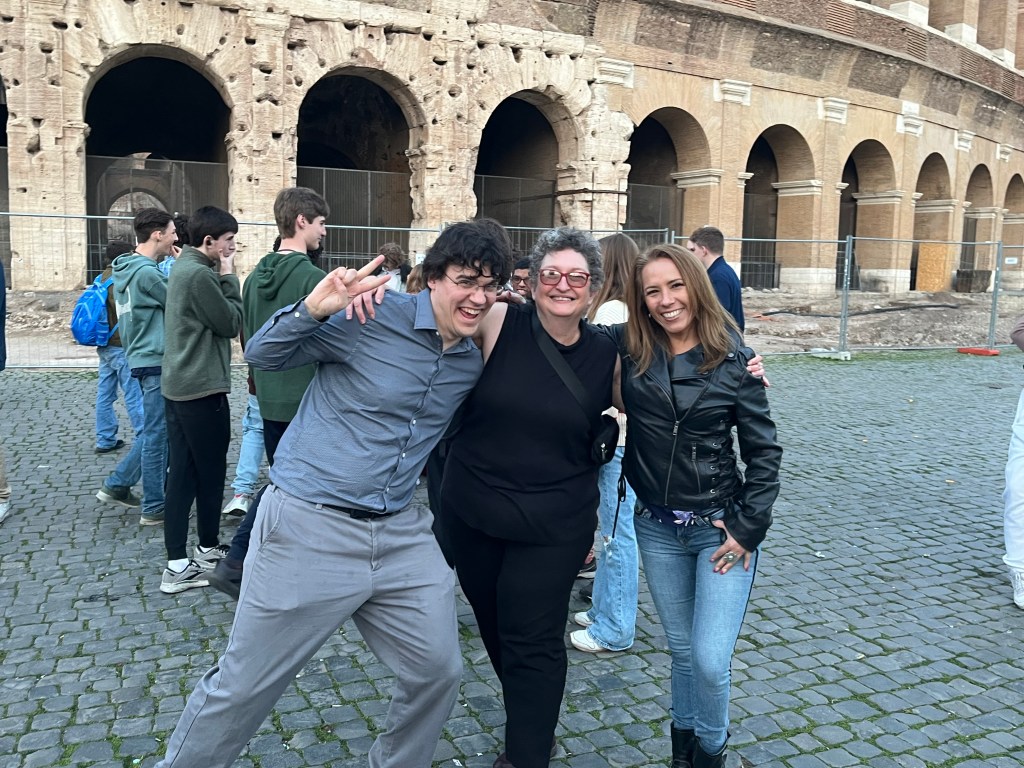
    Rome, Italy 2023 My colleague (left), my boss (right), and me (center) in foreground. In mid-ground a group of American high school students chatting. In background, the Coliseum.
    My colleague, my boss, and me (center) in front of the Coliseum in Rome, Italy (February 2023) Picture: my own

    It turned out to be the most rewarding six months of my career, in spite of it being a break from actually creating and implementing curriculum with my own students. I even took a quick side trip from Turin to Rome, just to see my Latin colleague and his students. It just so happened that my immediate supervisor was also a chaperone on that trip; she and I had had several – um, erm – misunderstandings before I took my sabbatical, but she remarked to me that she saw me with new eyes (and a new-found respect!) in Rome – and our working relationship improved greatly when I returned!

    Living and working part-time in Italy helped make me a much better and more compassionate teacher, with improved work-life balance and emphasis on self-care, on my return. It is really true: what is good for teachers, is good for students. I cannot emphasize enough how much this “time off,” a modified mini-retirement, increased my compassion, my commitment, and my productivity! 10/10 highly recommend!

    Introducing An American Teacher…

    This blog is dedicated to the varied interests of lifelong learners, from little-known local histories, to literary connections, to slow travel, to the quest for the perfect local foods. I am an American high school teacher but I have passions that go beyond the classroom and beyond my content area (Foreign/World Languages). I want to share those passions with other teachers, students, arm-chair travelers, slow travel explorers, foodies, trivia buffs, and anyone else who finds these topics interesting. New posts will arrive weekly, every Sunday morning. If you find this site interesting, please subscribe to this blog by entering your email address on the home page!

    The site title has an ellipsis (the three dots: An American Teacher…) because each post’s titles is meant to be a continuation of the site title (that is, the site title is the subject of the title). So, the post about the quest for the perfect Massachusetts lobster roll should ideally be read as follows: An American Teacher In Search of the Perfect Lobster Roll. 

    I am hoping to blog successfully over the next year and to host guest bloggers (fellow teachers, whether by profession or avocation). I hope many of you, dear readers, find this site interesting enough to subscribe yourself, and to tell your friends about. I hope to expand from the blog to a You Tube channel and possibly to a podcast. I hope to provide merch as well! Please join me in this exploration of our world and of the world of blogging!